
Cybersecurity for UK Schools: Safeguarding Students and Staff Online

Geraldine Hunt

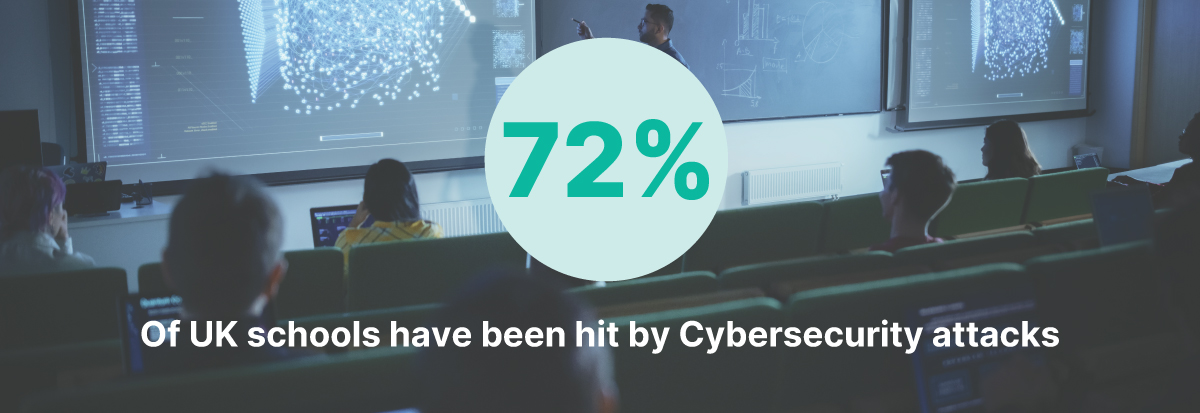
Cybercriminals view UK schools as easy targets. Research from ESET found that a staggering 73% of UK educational institutions had experienced a cyberattack over the last five years. The average attack incidence across other sectors is 50% of organizations. The ESET report also found that one-third of schools had inadequate protection against attacks.
Schools safeguard sensitive data and our children’s futures. That makes them prime targets for cybercriminals using phishing, ransomware, and other data-theft tactics to extort money and steal information.
Why Cybersecurity Matters in UK Education?
UK schools embrace technology to support teaching and enhance learning. Technologies such as AI have had significant investments from the Department for Education. For example, the UK government has recently invested over £4 million in AI tools for schools. However, with technology comes risks. Technology, in any sector, feeds off data. In the educational sector, the data includes student, staff, broader educational employees, and parent information. The data handled by an educational establishment typically includes financial data, health records, grades and attainments, and personal information. The IT departments within schools are usually small, and the users of school IT are often youngsters who may have little understanding of security. This is the perfect mix for a successful cyberattack.
Attackers are targeting schools to breach data and infect educational establishments with ransomware. Recent victims include Bacon High School , which resorted to remote learning after ransomware attacks.
According to UK government statistics , data breaches are prolific, with 71% of secondary schools identifying a breach or attack. Cybersecurity must become a priority for UK schools to protect school data, safeguard students, and maintain the integrity of our educational establishments.
Meeting UK Safeguarding & Ofsted Requirements
The UK Department for Education (DfE) sets out school security requirements. DfE requires seven core security standards to secure data. The required security measures are as follows:
- Conduct annual risk assessments and review each term
- Carry out security awareness training for staff and students
- Deploy anti-malware and a firewall to protect technology and data
- Use robust access control and identity security
- Use licensed software and keep software patched and updated
- Backup data
- Report security incidents
By following the seven security requirements, the DfE aims to help schools prepare for the growing threat of cyberattacks targeting the education sector.
In addition to cybersecurity measures, the DfE guidance document 'Teaching online safety in schools' expects a school to develop "a culture that incorporates the principles of online safety across all elements of school life. The principles should be reflected in the school's policies and practice where appropriate and should be communicated with staff, pupils/students, and parents."
As part of student safeguarding, Ofsted requires pupils to access and navigate the internet in an age-appropriate way. This access extends to protecting students from harmful content, including pornography, extremist material, self-harm material, and content promoting hate speech, drugs, and violence.
Web Filtering for UK Schools
Web filtering solutions provide a solution to the requirements of DfE and Ofsted in student safeguarding. Ofsted requires evidence that an educational establishment protects its students from potentially harmful online content.
The DfE "Filtering and monitoring standards for schools and colleges" states, "Schools and colleges have a statutory responsibility to keep children and young people safe online and offline." According to the DfE, web filtering prevents access to harmful content in text, images, audio, and video. The guidance points to the Internet Watch Foundation (IWF) and Counter-Terrorism Internet Referral Unit (CTIRU) for lists of illegal websites that web filtering solutions must block. In terms of what specifically to filter, the advice is that "The appropriateness of any filtering and monitoring systems is a matter for individual schools and colleges and will be informed in part by the risk assessment required by the Prevent Duty .”
DfE also highlights the use of devices not managed by the school, specifying that web filtering must extend to filtering all internet feeds, including all WiFi-enabled devices.
The department stresses that over-blocking must not occur, as it could impact a child’s learning. Web filtering solutions must be intelligent enough to modify blocklists to capture inappropriate content while ensuring that learning is not negatively impacted.


Email Protection in Education
Email is another area that is a target for attackers. According to a UK Government report , phishing is the most common type of breach, with 89% of primary and secondary schools experiencing phishing attacks. The report captured this statement from a secondary school educator, “We’re quite a big target [for phishing and ransomware attacks], obviously education is a massive target because we’ve got the money of the government and the academies behind us.”
Recent Cyber Scams Targeting UK Schools: A Growing Threat
Generalized email phishing can target students and staff, but spear phishing attacks will likely focus on a school's council or education management. Edinburgh Council recently identified a targeted phishing attack on schools and the early years network, which impacted exams.
In another email scam, a Wembley Multi-Academy Trust was tricked into sending over £385,000 when scammers posed as a building contractor, tampering with the legitimate supplier's email and tricking the school into paying the money to a hacker's bank account.
Email is a common way cybercriminals trick school staff and students into giving up their login details. One phishing campaign went undetected for six years, targeting users of Microsoft’s old SSO (single sign-on system). With tight budgets, many schools still rely on outdated software like this, making them easy targets for these kinds of attacks.
Advanced email protection is essential in education, where phishing attacks are common and evolving. The right solutions block widespread phishing attempts and detect and stop emerging threats like zero-day attacks before they can cause harm.
Did You Know?
cyber attacks begin with phishing
to seamlessly install PhishTitan
estimated global cybercrime cost
to stop & spot a phishing attack
Chromebooks, iPads, and Remote Learning
The COVID-19 pandemic saw UK schools close and remote learning normalized. This new era forced education departments to supply technology that facilitated online education. The devices of choice provided to students were iPads and Chromebooks. The increased use of remote learning has brought risks to data security and privacy, and access to inappropriate online content through unmanaged distance learning.
While devices like Chromebooks and iPads offer built-in security features such as encryption and ISO 27001-compliant cloud systems, they aren't foolproof. Their internet filtering often lacks the detail needed to protect students fully, and well-known brands like Google and Apple are frequent targets for cybercriminals. That’s why schools need extra layers of email security and web filtering tailored to education. These solutions must offer the precision required to meet Ofsted and DfE safeguarding standards and to keep students and their data safe.


Multi-Academy Trusts and Centralized Security
A Multi-Academy Trust or MAT benefits from centralized security deployment, management, and maintenance. A centralized approach streamlines operations and ensures that security is cost-effective across the academies under the control of the MAT. Some of the benefits of using a centralized approach to security include:
- Centralized Visibility: A MAT must oversee multiple schools. A centralized management system provides visibility into the school environment, allowing the MAT to see the security posture of all schools under its watch.
- Simplify Management: Centralizing management consolidates and reduces the workload of the MAT's IT staff.
- Cost Savings: Consolidating solutions from a central console reduces staff overhead and can lower overall costs.
- Compliance: A MAT can track and maintain compliance with regulations and standards like UK safeguarding and Ofsted by centralizing security management.
- Efficient and Effective Threat Detection and Response: Advanced, cloud-based security solutions utilize advanced analytics and machine learning, allowing them to respond to threats, including emerging threats.
Why Schools Choose TitanHQ
TitanHQ provides affordable, unified email security and web filtering explicitly designed for schools and Multi-Academy Trusts. Our solutions make it easy to manage everything in one place, giving clear oversight and helping you comply with UK Safeguarding and Ofsted requirements.
Our AI-driven email security and web filtering solutions are designed to work with Chromebooks. Our solutions provide comprehensive, work-from-anywhere support so that students and staff are protected no matter where they work or access the internet.
TitanHQ solutions are flexible and enforce granular policies that reflect the complexity of school demographics.
Why Schools Trust TitanHQ: Key Benefits of Our Solutions for the UK Education Sector
- Full cloud deployment with no hardware required
- UK-based support and compliance expertise
- Easy setup and low admin burden for IT teams
- Granular age-based policies and user group controls
- Transparent, scalable pricing vs. competitors
WebTitan, a web filtering solution, customer testimonials speak for themselves.
It didn’t take long to realize that WebTitan was the best alternative for an efficient, cost-effective, easy-to-use web filtering solution to replace Cisco Umbrella. The entire experience with WebTitan has been terrific. From better reporting to a usable UI. We've gotten the visibility we need and have therefore been able to improve our security position.
Get Started with TitanHQ
Protect your students and staff with TitanHQ’s safeguarding-compliant web filtering and email security. Designed for schools and Multi-Academy Trusts, TitanHQ makes it easy for IT teams to manage protection and meet compliance. Get in touch to see how we can help keep your school safe.
Sources
- Meeting digital and technology standards in schools and colleges
- New research highlights crucial cybersecurity gaps in education sector
- Ransomware attack forces Brit high school to shut doors • The Register
- Cyber security breaches survey 2024: education institutions annex - GOV.UK
- Eliminating Child Sexual Abuse Online | Internet Watch Foundation IWF
- The Prevent duty: safeguarding learners vulnerable to radicalisation - GOV.UK
- Cyber security breaches survey 2025: education institutions findings - GOV.UK
- Targeted phishing attack – The City of Edinburgh Council
- Wembley Multi-Academy Trust Scammed Out of £385,000
Frequently Asked Questions (FAQs)
Ofsted requires that a school use some form of web filtering to ensure that students do not view or interact with potentially inappropriate material. The guidelines for what constitutes inappropriate content are not clear. Ofsted also stresses the importance of not "over-blocking." However, using an advanced web filtering solution that can be tailored using granular policies so that a school can modify its blocklist without over-blocking and impacting a student's education.
TitanHQ's email filtering solution, SpamTitan, is an award-winning cloud-based solution with no hardware or software requirements. Using AI-enabled detection and real-time threat analysis, SpamTitan has a 100% catch rate for malware and phishing. TitanHQ wins awards for our email security suite—read more here: "Third Consecutive VBSpam+ Award for its Email Security Suite."
WebTitan and SpamTitan are designed with Chromebooks use in mind. As a cloud-based centralized service, our email security and web filtering are fast and straightforward to deploy and manage. Our web filtering solution, WebTitan, is designed to be fully compliant with Ofsted's web filtering requirements, and our email security uses advanced AI-enabled detection to identify emerging and zero-day threats.
Geraldine Hunt
- DNS FILTERING
- EDUCATION
- SCHOOLS
Get a Demo or Trial Today
