

Ransomware is the fastest-growing form of cybercrime. Having experienced explosive growth in popularity over the past decade, these attacks show no signs of slowing down. AI is now helping cybercriminals to refine and automate their tactics, with research suggesting that by 2031, over 43,000 ransomware attempts will be launched per day – one every two seconds.
Ransomware’s popularity stems from two key factors: its high profitability and low risk. Attacks are carried out remotely, and ransoms are paid using cryptocurrency, making it easy to launder the proceeds. The rise of Ransomware-as-a-Service (RaaS) has also lowered barriers to entry, allowing even those without sophisticated technical skills to try their hand at cybercrime.
UK Education Under Threat
Educational institutions are now the most targeted sector for ransomware attacks. In the first quarter of 2025, the global education sector faced 4,484 attacks per week. That was more than government agencies, healthcare organizations, or any form of private industry. Schools’ combination of broad datasets and weak security levels compared to government or enterprise environments has turned education into attackers’ most popular hunting ground.
This situation is particularly pronounced in the UK. Nationally, 52% of primary schools and 71% of secondary schools have identified a cyber breach or attack in the past year. The picture is even bleaker for colleges and universities, where 86% and 97% of institutions have had their defenses breached, respectively. Ransomware forms are a key part of these incidents, with a higher percentage of attacks impacting further and higher education institutions than the overall business sector.
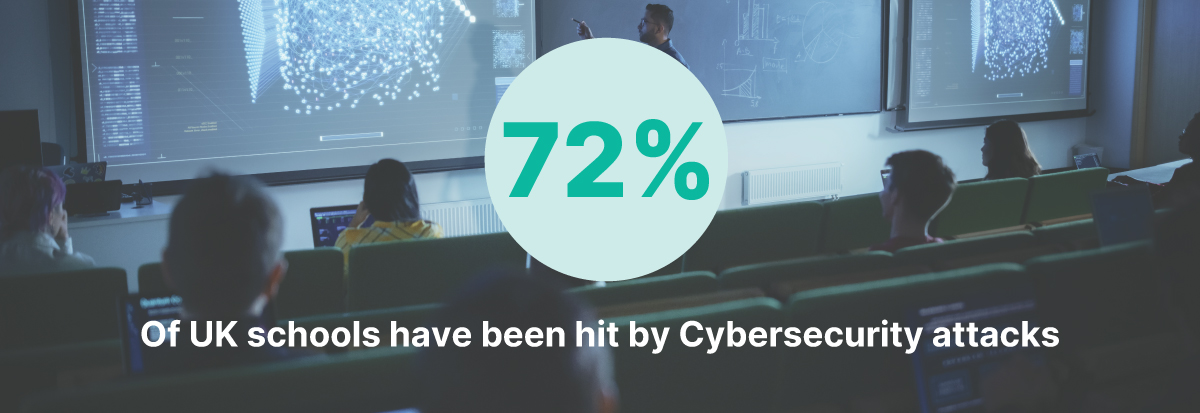
Did You Know?
cyber attacks begin with phishing
ransom paid by a university to decrypt files
increase in ransomware attacks targeting the education sector
surge in attacks against schools in 2024
Notable Ransomware Incidents in Education
More than 50 UK schools have reported ransomware attacks to the Department for Education in the last three years. Reporting is not mandatory, and there is no central register, meaning the true number may be even higher. Some of these attacks have crippled schools, leading to closures, cancelled exams, and systems being taken offline for multiple weeks.
West Lothian Education Network
In May 2025, West Lothian’s education network, comprising 69 primary schools and 13 secondary schools, was targeted by the Interlock ransomware group. Among the data stolen by the attackers was personal and sensitive data, including the driving licenses and passports of teachers, parents, and guardians.
Fylde Coast Academy Trust
The Rhysida ransomware group disrupted systems across 10 of Fylde Coast Academy Trust’s schools in September 2024. The hackers stole personal and sensitive data on current staff and former employees. This included names, addresses, national insurance numbers, and bank details. They also extracted student details, including names, emails, and pupil support statuses. The attack disrupted IT systems for several weeks, with Rhysida demanding a ransom of £1.2 million. The trust invested around £300,000 in its cyber resilience following the attack.
Hardenhuish School
In April 2023, Hardenhuish School was victim to a ransomware attack that crippled its IT infrastructure, including local servers, website, internet access, Wi‑Fi and internal telephone systems. The attack affected 1,623 pupils and required the involvement of forensic experts to restore operations. The school was forced to revert to paper-based registers and allowed students to use personal devices to maintain operations.
The Thomas Hardye School
The Thomas Hardye School suffered a ransomware attack in May 2023 that encrypted its servers and backups. The attack locked staff out of email and payment systems, as well as preventing access to electronic records. The school collaborated with the National Cyber Security Centre, the police, and exam boards to manage the crisis and ensure that A-level and BTEC exams continued uninterrupted.
Universities as Primary Targets
Universities pose a desirable target for attackers. Students at the university level often have access to financial information that can be stolen and used for fraudulent purposes, unlike school-age children. University research and intellectual property are also highly valued for their commercial potential. Many of these institutions also lack robust backup strategies due to the associated costs.
Once an attacker has installed ransomware, the next step is to extort money from the victim. Attackers assume universities have millions to spend on retrieving their data. In some cases, educational institutions have no choice but to pay the ransom. Even this doesn’t guarantee an end to the ordeal. Attacks often refuse to decrypt stolen data even if the ransom has been paid.
Common Entry Points for Ransomware Attacks
Educational institutions are particularly vulnerable to ransomware due to a combination of limited cybersecurity resources, decentralized IT systems, and a high volume of users. One of the most common entry points is phishing emails, which trick staff or students into clicking malicious links or downloading infected attachments. These emails often impersonate school officials or trusted vendors, exploiting trust and creating a sense of urgency.
Another key entry point is unpatched software or outdated operating systems. Schools often rely on legacy systems that lack recent security updates, creating exploitable vulnerabilities. Similarly, Remote Desktop Protocol (RDP) exploitation is a frequent tactic used by attackers to gain unauthorized access to networks with weak or reused passwords.
Compromised third-party applications and learning management systems (LMS) also present significant risks. If vendors or partners are breached, attackers can use their access to infiltrate institutional networks. Moreover, USB devices and personal laptops, especially in bring-your-own-device (BYOD) environments, can introduce malware if proper endpoint protection is not enforced. Finally, poor user security awareness and training play a significant role. With a large and transient user base, especially students, security practices are often inconsistent, making it easier for attackers to exploit human error and gain initial access to systems.

The High Cost of Downtime and Data Loss for Schools Following a Ransomware Attack
When a ransomware attack hits a school, the impact goes far beyond locked files and disrupted systems; it can bring the entire institution to a standstill. Downtime means classes are cancelled, administrative operations are halted, and a complete communication breakdown. Teaching and learning often grind to a halt for days or even weeks, while IT teams scramble to assess the damage and restore systems. The financial toll is significant, with schools facing substantial costs related to system restoration, data recovery, legal fees, and even ransom payments if no viable backups are in place. But the hidden costs can be just as damaging: reputational harm, lost trust from parents and students, and the potential for long-term enrolment declines.
The risk of data loss is a significant concern. Student records, staff information, grades, and financial data are all highly sensitive and confidential. If stolen or permanently lost, it can lead to identity theft, privacy violations, and compliance issues with regulations. For many educational institutions, the resources to fully recover may not exist, meaning the consequences of a ransomware attack can impact long after the initial breach, both financially and operationally.
How TitanHQ Prevents Ransomware
Most ransomware starts with a phishing email; the most effective way to stop it is to block malicious email messages from reaching a user’s inbox. However, this shouldn’t be your only defense. Educating employees on how to identify a phishing email is also essential to prevent other forms of human error. Even with a limited budget, school districts and universities can still take the necessary steps to stop ransomware. TitanHQ’s advanced email security solutions and behavior-led security awareness training are designed with educational establishments in mind. Our cost-effective AI-enabled solutions are cloud-based and easy to configure and deploy.
Whether you’re a university, school, or school district, protecting your environment from ransomware should be a primary concern. Ransomware can weaken an educational establishment and impact education for weeks. With email cybersecurity that blocks malicious messages and employee education, you significantly reduce your risk of a ransomware incident.
Let us show you how TitanHQ can help prevent ransomware infection. Sign up for a demo today to get started with TitanHQ's advanced email security and behavior-led security awareness training.

Geraldine Hunt
- EMAIL PROTECTION
- EDUCATION
- SCHOOLS
Get a Demo or Trial Today
